1. Publication Draft North East Derbyshire Local Plan 2024 - 2044 (Reg 19)
Other elements in this consultation
3 Vision and Objectives Comment
3.1 Introduction Comment
This chapter sets out the underlying thinking behind the Plan. It consists of a Plan vision together with a set of accompanying strategic objectives. The Plan’s vision sets out how the area and places within it should develop over the long term, as well as providing a clear framework for the Plan’s policies.
3.2 Vision Comment
In 2023 the Council published its Corporate Plan 2023 – 2027 following consultation with local community organisations. The Corporate Plan sets out a vision centred around four main objectives in order to make North East Derbyshire ‘a great place.’ The Council’s Corporate vision is that by:
‘Putting strong community leadership at the heart of everything we do, we will create A Great Place...’
The four key priorities set out in the Corporate Plan for achieving this vision are:
- A great place that cares for the environment;
- A great place to live well;
- A great place to access good public services; and
- A great place to work.
The following vision for the Local Plan builds on this corporate vision and its growth aspirations, setting out how the Plan area will develop over the plan period:
“By 2044, North East Derbyshire will be a sustainable, healthy and thriving District that has successfully balanced growth with protecting and enhancing the District's distinctive character, landscapes, communities and the individual identities of its towns and villages.
The District will have delivered the homes, jobs, services and infrastructure needed to support an ageing population whilst also attracting and retaining younger people and families.", whilst maintaining its attractive rural setting, strong sense of place and network of towns and villages. Development will be focused in the most sustainable locations, helping to reduce health, social and economic inequalities across the district, improve access to opportunities and support vibrant and resilient communities.
Action to mitigate and adapt to climate change will have been embedded throughout the District's growth, delivering low-carbon development, sustainable travel choices, renewable energy generation, greater climate resilience and a recovering natural environment. A connected network of green and blue infrastructure will support nature recovery, biodiversityenhancement, healthier lifestyles and improved access to the countryside.
North East Derbyshire will have strengthened its role within the wider economies of Chesterfield, South Yorkshire and the East Midlands, supporting investment, innovation, skills development and opportunities that help retain and attract people of working age. . Its town centres will continue to provide attractive and accessible places for shopping, services, leisure and community activity, whilst the rural economy and visitor economy will continue to flourish.
New development will be supported by the timely provision of infrastructure and will contribute positively to the District's distinctive landscapes, historic environment and local character, creating beautiful, well-designed and sustainable places in which people can live, work and enjoy healthy lives.”
3.3 Vision Delivery Statements Comment
3.3.1 The District Comment
The District will have accommodated sustainable growth that meets its development needs whilst reducing inequalities, supporting healthier communities and ensuring that development contributes positively to climate resilience, nature recovery and environmental quality. This will be achieved by:
- directing growth to the most sustainable locations in accordance with the settlement hierarchy;
- delivering homes to meet a wide range of needs, including affordable housing, homes for older people, younger households and families;
- growing and diversifying the local economy and supporting higher-value employment opportunities;
- strengthening town, local and village centres as focal points for services, employment and community activity;
- ensuring strategic growth is supported by appropriate physical, social, environmental and digital infrastructure;
- supporting sustainable travel and improving connectivity both within the District and to neighbouring economic centres;
- addressing climate change through carbon reduction, renewable energy generation, sustainable design and climate adaptation measures;
- protecting and enhancing biodiversity, landscape character, green and blue infrastructure networks and opportunities for countryside access;
- conserving and enhancing the District's historic environment and local distinctiveness; and
- securing high-quality, well-designed development that creates attractive, healthy and sustainable places.
3.3.2 Northern Area Comment
Dronfield, Eckington and Killamarsh will have accommodated sustainable growth that meets local housing and employment needs, supports town centre regeneration and improves access to services and sustainable transport.
Development will have been planned to minimise impacts on the Green Belt, maintain settlement identity and provide enduring and defensible boundaries.
3.3.3 Southern Area Comment
Clay Cross and the surrounding communities will have strengthened their role as an important focus for housing, employment, services and community facilities. Regeneration and investment will have improved prosperity, wellbeing and opportunities for local people whilst maintaining the separate identity and character of individual settlements.
3.3.4 Eastern Area Comment
The eastern part of the District will have capitalised on its strategic location close to the M1 corridor, Chesterfield and Markham Vale, supporting sustainable economic growth, investment and job creation. Growth will have been accompanied by environmental improvements, infrastructure enhancements and the regeneration of previously developed land whilst protecting important heritage assets and their settings.
3.3.5 Western Area Comment
The western part of the District will continue to be recognised for its high-quality landscapes, rural character and relationship with the Peak District National Park. Rural communities will remain vibrant and sustainable, supported by appropriate housing, employment, tourism and diversification opportunities, whilst biodiversity, heritage assets and landscape character will have been conserved and enhanced.
3.4 Local Plan Objectives Comment
The strategic objectives establish the outcomes that the Local Plan will seek to achieve over the plan period. They respond to the opportunities and challenges identified in the Spatial Portrait and provide the link between the Plan’s vision, spatial strategy, site allocations and policies. Tackling and adapting to climate change, reducing inequalities, delivering infrastructure and promoting sustainable development are cross-cutting priorities that apply across the full set of objectives.
3.5 Strategic Objectives Comment
Tackling and adapting to climate change will be a cross-cutting priority informing the spatial strategy, site allocations and implementation of all the strategic objectives.
3.5.1 Economy Comment
SO1: Sustainable Economic Growth
To support a strong, resilient and productive economy by providing sufficient land, premises and infrastructure to meet identified economic needs; enabling businesses to invest, expand and adapt; supporting inward investment, innovation and growth sectors; and strengthening the District’s role within the wider economies of Chesterfield, South Yorkshire and the East Midlands.
SO2: Jobs, Skills and Opportunity
To improve access to employment, education and training; address skills shortages; support higher-value employment; raise productivity and earnings; retain and attract working-age people; and reduce economic inequalities across the District.
SO3: Town and Local Centres
To strengthen the vitality, viability and resilience of the District's town and local centres as accessible and attractive locations for shopping, services, employment, leisure, cultural activity and community life, supporting their regeneration and continued role as the focus of sustainable communities.
SO4: Tourism and the Rural Economy
To support a prosperous and resilient rural economy by encouraging sustainable tourism, recreation, cultural activity, farm diversification and rural enterprise, building upon the District's countryside, heritage assets, visitor attractions and its role as the gateway to the Peak District National Park.
3.5.2 Homes and Communities Comment
SO5: Housing to Meet Local Needs
To deliver sufficient homes to meet identified needs and support housing delivery, including affordable housing and social rent, homes for families and younger households, accessible and adaptable homes, specialist and supported accommodation, homes for older people, and provision for Gypsies and Travellers, providing an appropriate mix of types, sizes and tenures.
SO6: Healthy, Safe and Inclusive Communities
To improve physical and mental health outcomes and reduce health and social inequalities across North East Derbyshire by promoting healthy placemaking, healthy homes, active and sustainable travel, access to healthcare, education, recreation and community facilities, high-quality green and blue infrastructure, and the creation of safe, accessible and inclusive communities.
3.5.3 Environment and Place Comment
SO7: Climate Change, Net Zero and Resilience
- To ensure development helps mitigate and adapt to climate change by:
- reducing greenhouse gas emissions;
- minimising energy demand and improving energy efficiency;
- supporting renewable and low-carbon energy generation;
- promoting resilient, resource-efficient and low-carbon development;
- applying sustainable water management and drainage;
- reducing and managing flood risk;
- addressing overheating, water scarcity, drought and extreme weather; and
- using green infrastructure and nature-based solutions to increase climate resilience and carbon sequestration.
SO8: Sustainable Pattern of Development
To direct growth to sustainable locations in accordance with the settlement hierarchy, making efficient use of land and existing or planned infrastructure, services and public transport; reducing the need to travel and associated carbon emissions; protecting the Green Belt; maintaining settlement identity and separation; and conserving valued countryside and landscapes.
SO9: High-Quality Design and Placemaking
To ensure development creates high-quality, attractive, healthy, safe, inclusive and sustainable places that respond positively to local character, landscape, townscape, heritage and settlement identity; use land efficiently; and contribute to a strong sense of place.
SO10: Historic Environment
To conserve and, where appropriate, enhance the District’s historic environment, including designated and non-designated heritage assets, archaeological remains, historic landscapes and industrial heritage, together with their significance, character and settings.
SO11: Nature Recovery, Landscape and Green Infrastructure
To protect, enhance and restore biodiversity, geodiversity, landscape character and interconnected green and blue infrastructure by:
- supporting nature recovery and ecological connectivity;
- securing measurable improvements in biodiversity;
- protecting and strengthening ecological networks;
- protecting internationally, nationally and locally important sites, habitats and species;
- supporting carbon storage and other ecosystem services;
- conserving distinctive landscapes and the setting of the Peak District National Park;
- improving access to high-quality natural and semi-natural spaces; and
- securing the restoration and enhancement of the Chesterfield Canal,
SO12: Sustainable Transport and Connectivity
To improve connectivity within and beyond the District by supporting:
- patterns of development that reduce the need to travel;
- convenient access to jobs, services and facilities;
- reliable and accessible public transport;
- safe walking, wheeling and cycling networks;
- modal shift away from private car use;
- the transition to low- and zero-emission transport;
- appropriately located transport, freight and logistics infrastructure; and
- improved digital connectivity.
SO13: Environmental Quality and Amenity
To protect and improve air, water and soil quality; reduce pollution, waste and land contamination; safeguard mineral and other natural resources; and ensure development protects the health, safety and amenity of existing and future communities.
3.5.4 Regeneration and Delivery Comment
SO14: Regeneration and Efficient Use of Land
To support the regeneration of town centres, former industrial land, previously developed land and other underused sites, where appropriate, to deliver homes, jobs, environmental improvements and community benefits; address deprivation and inequalities; remediate unstable or contaminated land; and make effective use of land while recognising that greenfield development will also be required to meet identified needs.
SO15: Infrastructure, Delivery and Strategic Collaboration
To ensure development is supported by the timely and coordinated delivery of the physical, social, transport, environmental, utilities and high quality digital and telecommunications infrastructure needed to create sustainable communities, working proactively with neighbouring authorities, infrastructure providers, delivery bodies and other partners to:
- coordinate development and infrastructure;
- address strategic and cross-boundary matters;
- support the delivery of strategic sites;
- identify and overcome infrastructure constraints; and
- ensure that development is viable and deliverable.
3.5.5 Place-Based Objectives Comment
PO1: Northern Area
To support sustainable growth and regeneration in Dronfield, Eckington and Killamarsh, meeting identified housing and employment needs, strengthening town centres and local services, and improving sustainable connections with Sheffield and neighbouring areas, while protecting the Green Belt and maintaining the identity of settlements.
PO2: Southern Area
To support the continued growth and regeneration of Clay Cross and surrounding communities through the coordinated delivery of homes, employment, services and infrastructure, while addressing inequalities, making effective use of previously developed land and safeguarding the identity and separation of settlements.
PO3: Eastern Area
To realise the area’s potential for sustainable economic growth and regeneration associated with the M1 corridor, Markham Vale and other strategic employment locations; support the remediation and redevelopment of previously developed land; secure necessary transport and environmental infrastructure; and conserve heritage assets, landscapes and their settings.
PO4: Western Area
To support the vitality of rural communities, the visitor economy and appropriate rural enterprise while conserving and enhancing landscape character, biodiversity, heritage, tranquillity and the setting of the Peak District National Park, and improving sustainable access to services and the countryside.
3.5.6 Relationship between Objectives and Policies Comment
The strategic objectives take forward the Vision for North East Derbyshire and provide a clear framework for delivering sustainable development across the District. They identify the key social, economic and environmental outcomes that the Local Plan seeks to achieve over the plan period and respond to the opportunities and challenges identified in the Spatial Portrait.
The policies of the Local Plan are the means through which the Vision and strategic objectives will be delivered. Together, they provide the framework for guiding growth, making decisions on development proposals and securing sustainable development in accordance with the spatial strategy.
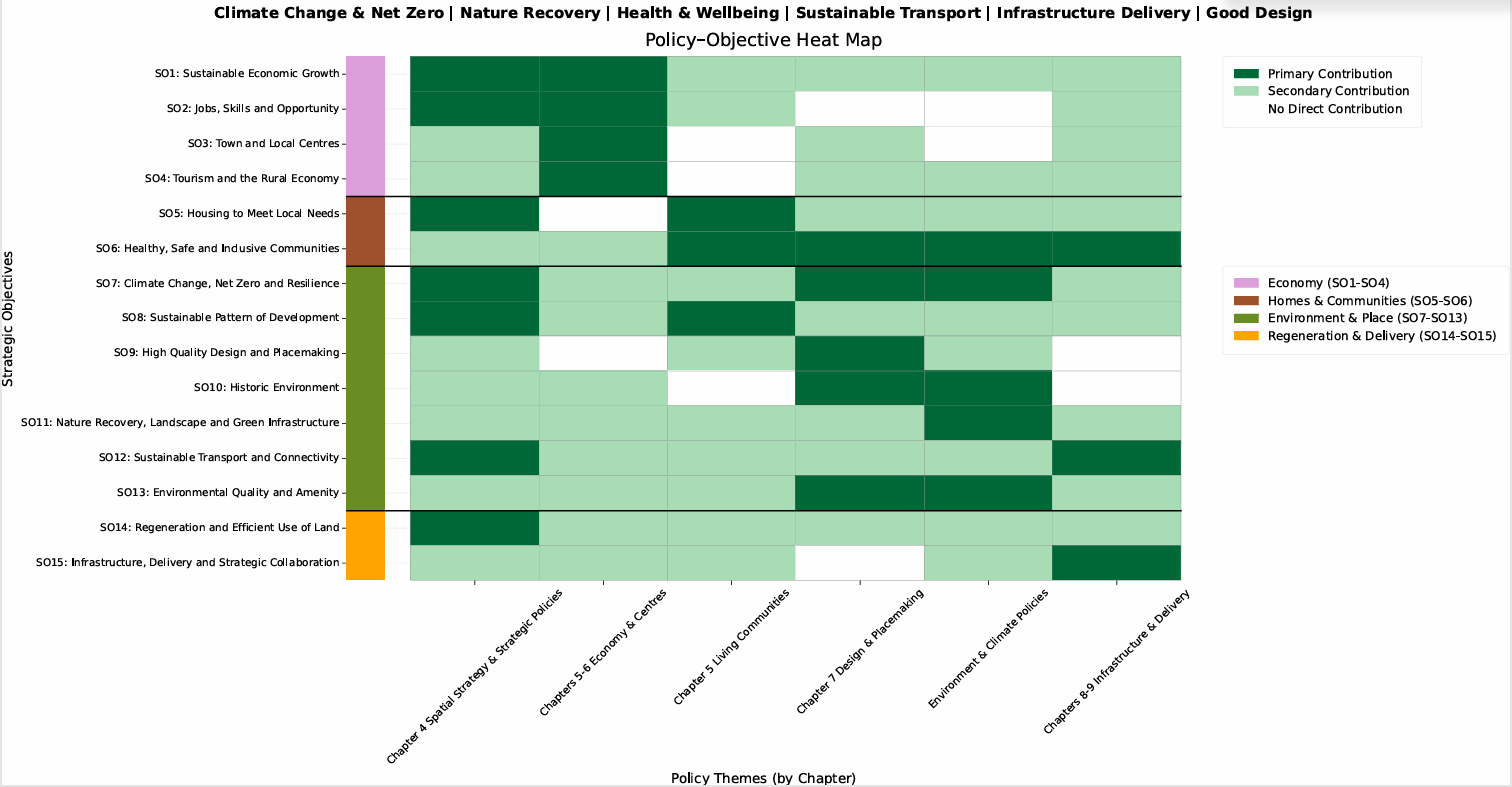
Many of the objectives are interrelated and will be delivered through a combination of strategic, development management and site allocation policies. Climate change, nature recovery, health and wellbeing, sustainable transport, infrastructure delivery and good design are cross-cutting themes that underpin the Plan as a whole. Consequently, individual policies may contribute towards the achievement of several objectives.
Figure 3.1 illustrates the relationship between the strategic objectives and the Local Plan policies by chapter and demonstrates how the policy framework contributes to the delivery of the Vision. The matrix demonstrates how the strategic objectives are delivered through the combined operation of the Plan's policy framework. Dark green shading indicates a primary contribution and light green shading indicates a secondary contribution. Climate change, nature recovery, health and wellbeing, sustainable transport, infrastructure delivery and good design are cross-cutting themes that underpin all policy areas.
Figure 3.1: Relationship between Strategic Objectives and Local Plan Policy Chapters.